A reflection by Karena Liebetrau, short course participant of the Corporate Transitions for Sustainable Futures short course, June 2026
My introduction to corporate sustainability came through an MBA at the Copenhagen Business School. While the frameworks I encountered (namely double materiality, stakeholder theory, shared value creation, and ESG) were deeply valuable and formative for my understanding of the subject, I also recognised that they had largely been conceived of, and presented through, the lens of the global North.
When I enrolled in the Sustainability Institute’s Corporate Transitions for Sustainable Futures course, I wanted to do two things: first, ground my understanding of corporate sustainability in the South African context; and second, explore how corporate sustainability might apply to the commercial art world, where it is largely overlooked and undeveloped.
The context
The course’s early modules made it clear that sustainability in South Africa cannot be understood without an awareness of the country’s particular histories. Current social and economic inequality is deeply rooted in legacies of settler colonialism, racial capitalism, mineral extraction, the migrant labour system, and structural unemployment. For me, the course surfaced important tensions around the role of South African businesses in responding to social and economic challenges that should otherwise be the state’s responsibility, from youth unemployment to housing and basic service delivery.
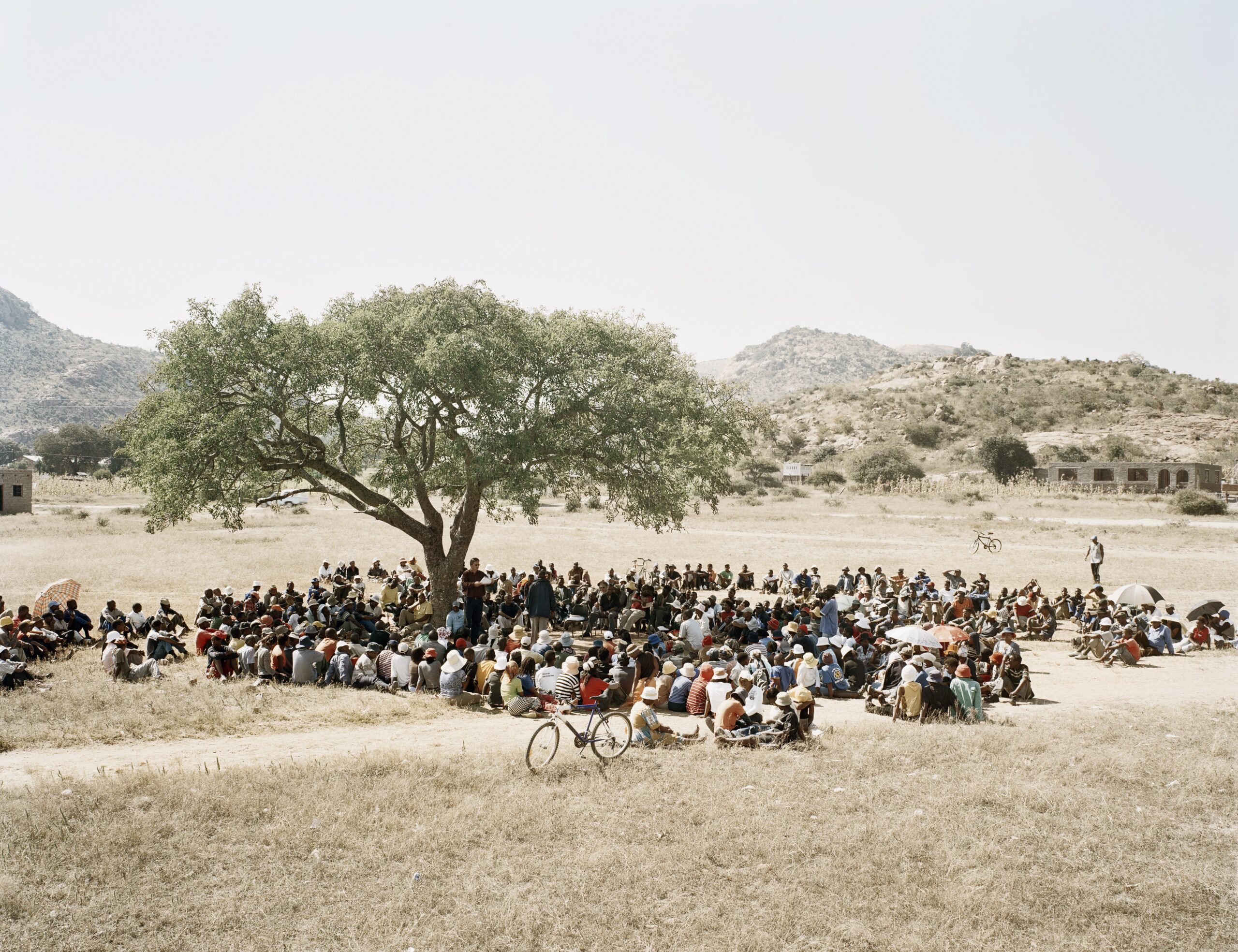
To anchor my learnings and the themes presented in each module, and to bring them into alignment with my own background in art history, I selected an image by a different South African photographer each week. For example, one of the images I chose was David Goldblatt’s A consultation under a maroela tree between the Mohlohlo farming community and their lawyers, Richard Spoor and Steven Goldblatt, to discuss attempts by the Anglo-American Corporation to force the community off their land to make room for a platinum mine. Mokopane, Limpopo Province (2006). Together with its title, this photograph quietly presents a case study of the entanglements of land, power, corporate interest, and community engagement.
The case study
I chose to apply my understanding of the course’s sustainability frameworks to the visual art sector, with a specific focus on commercial art galleries. Where sustainability is discussed in the sector, it often refers specifically to carbon emissions from artwork transport and staff travel or is misinterpreted to mean philanthropy or Corporate Social Responsibility (CSR). While not to diminish the importance of these initiatives, it is my assertion that they do not address some of the more pressing social issues and tensions in the art world, such as equity and access, freedom of expression and political voice.
In South Africa, the absence of well-resourced public art institutions means that the visual art sector is, for the most part, concentrated within a relatively small sphere of commercial galleries that ultimately shape who (that is, which artists and cultural practitioners) does and does not have access, who is visible and who is not. Furthermore, they occupy a complex position where they can both support critical creative practice and provide a platform for artists to express perspectives that may otherwise be marginalised. At the same time, they are commercial entities beholden to market demands and even larger geopolitical pressures.
To this extent, commercial art galleries are embedded in and shaped by broader social, political and economic pressures rather than operating in isolation. As such, they should be understood as no different from businesses in other sectors that must navigate increasing complexity and uncertainty. They warrant the same strategic approach to sustainability, where a credible sustainability strategy could be particularly valuable in supporting their long-term resilience. This is especially important as the global art market contracts, state funding for the arts is slashed, and galleries are increasingly required to move beyond rigid business models towards more adaptive ways of operating.
The Corporate Transitions for Sustainable Futures short course helped me to see commercial art galleries through a systems lens, and to better understand how they operate in relation to both their immediate context and broader social, political and economic forces.
My intention was not to complete the course with a fully developed sustainability strategy, but rather with a clearer way of thinking about a sector in which I have worked for over a decade. The course helped me to achieve exactly that.